
Kia Telluride: Tires and wheels / Tire replacement
When a tire wears down evenly across its contact patch, a built-in tread wear indicator becomes visible as a continuous solid rubber band running perpendicular across the tread grooves.
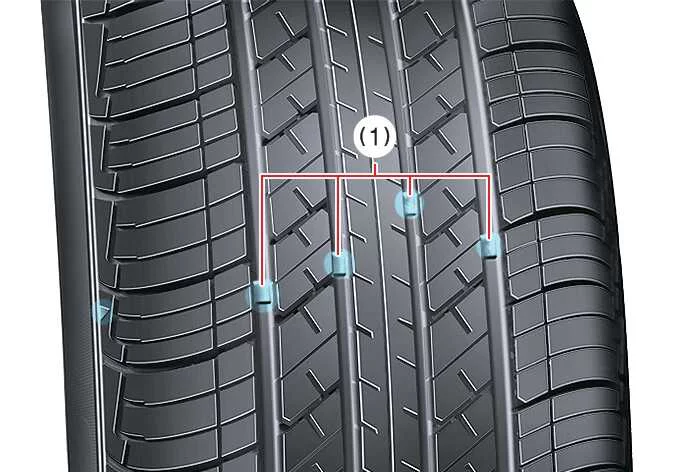
|
|
The appearance of this solid bar indicates that the remaining tread depth has reached a critical threshold of less than 1/16 inches (1.6 mm). You must replace the affected tire as soon as this wear bar becomes clearly visible.
For optimal driving safety and wet road grip, do not wait until the wear indicator bar extends completely across the entire width of the tread before installing new tires on your Kia Telluride.
The Anti-lock Brake System (ABS) and Electronic Stability Control (ESC) continuously monitor and compare rotational speed readings from all four wheel sensors. Because overall tire diameter directly dictates rotational speed, installing replacement tires that match the original equipment dimensions supplied with your vehicle is vital. Equipping tires of incorrect or mismatched sizes alters wheel speed calculations, preventing the ABS and ESC systems from functioning accurately during critical driving maneuvers.
To preserve ideal handling dynamics and consistent chassis balance in your Kia Telluride, it is always recommended to replace all four tires simultaneously. If replacing the complete set is not feasible, always install new tires as a matching axle pair across the front or rear. Replacing only a single tire creates tread depth and traction discrepancies, which can adversely impact steering feedback, vehicle stability, and overall braking predictability.
WARNING
When replacing tires on your Kia Telluride, ensure the new units match the exact specification type and dimension standards as the original factory equipment to prevent unpredictable handling, reduced driving performance, or compromised electronic safety features.
Compact spare tire replacement: (if equipped)
The temporary compact spare tire provided with your Kia Telluride features a thinner tread layer and a significantly shorter operational lifespan than a standard full-size highway tire. Promptly replace the compact spare as soon as the raised tread wear indicator bars become visible across its surface grooves.
Any replacement compact spare tire must match the exact dimensions, load index, and construction design of the original factory spare, and it must be mounted exclusively on the original compact spare wheel rim.
Never attempt to mount a temporary compact spare tire onto a full-size wheel rim, nor should you attempt to fit a standard full-size tire onto the dedicated compact spare wheel rim, as these components are engineered with incompatible rim profiles.
 Tire traction
Operating your Kia Telluride on worn tread, underinflated or overinflated tires, or hazardous road surfaces like wet asphalt, slush, and black ice significantly diminishes overall tire traction, extending braking distances and compromising vehicle stability...
 Wheel replacement
If you ever replace the factory metal wheels on your Kia Telluride due to damage or customization, ensure the replacement wheels precisely duplicate the original factory units in overall diameter, rim width, bolt pattern, and offset geometry...
Other information:
Kia Telluride (LQ2, 2027-2026) Owner's Manual: Remote Smart Parking Assist (RSPA): (if equipped)
Remote Smart Parking Assist leverages a comprehensive suite of advanced front, front-side, rear-side, and rear ultrasonic sensors strategically positioned around the vehicle. This intelligent driver-assistance system actively detects suitable parking spaces and manages automated steering, speed control, and smooth gear transitions.
Kia Telluride (LQ2, 2027-2026) Owner's Manual: Active Air Flap (AAF): (if equipped)
The Active Air Flap (AAF) system in the Kia Telluride controls the air flap located below the front bumper to help manage airflow for component cooling and improved fuel efficiency. Active Air Flap malfunction Check Active Air Flap system The Active Air Flap system may not operate normally if the flap is temporarily held open by foreign material, or if the controller area is affected by snow, rain, ice, dirt, or other external conditions.