
Kia Telluride history: from concept to flagship
THE STORY BEHIND THE NAMEPLATE
The Telluride gave Kia a different kind of presence: an upright, spacious SUV with room for family life and a design that did not need to look delicate to feel expensive. Its story runs from a show-car idea to a production model, a substantial refresh and, finally, a new generation with hybrid power.
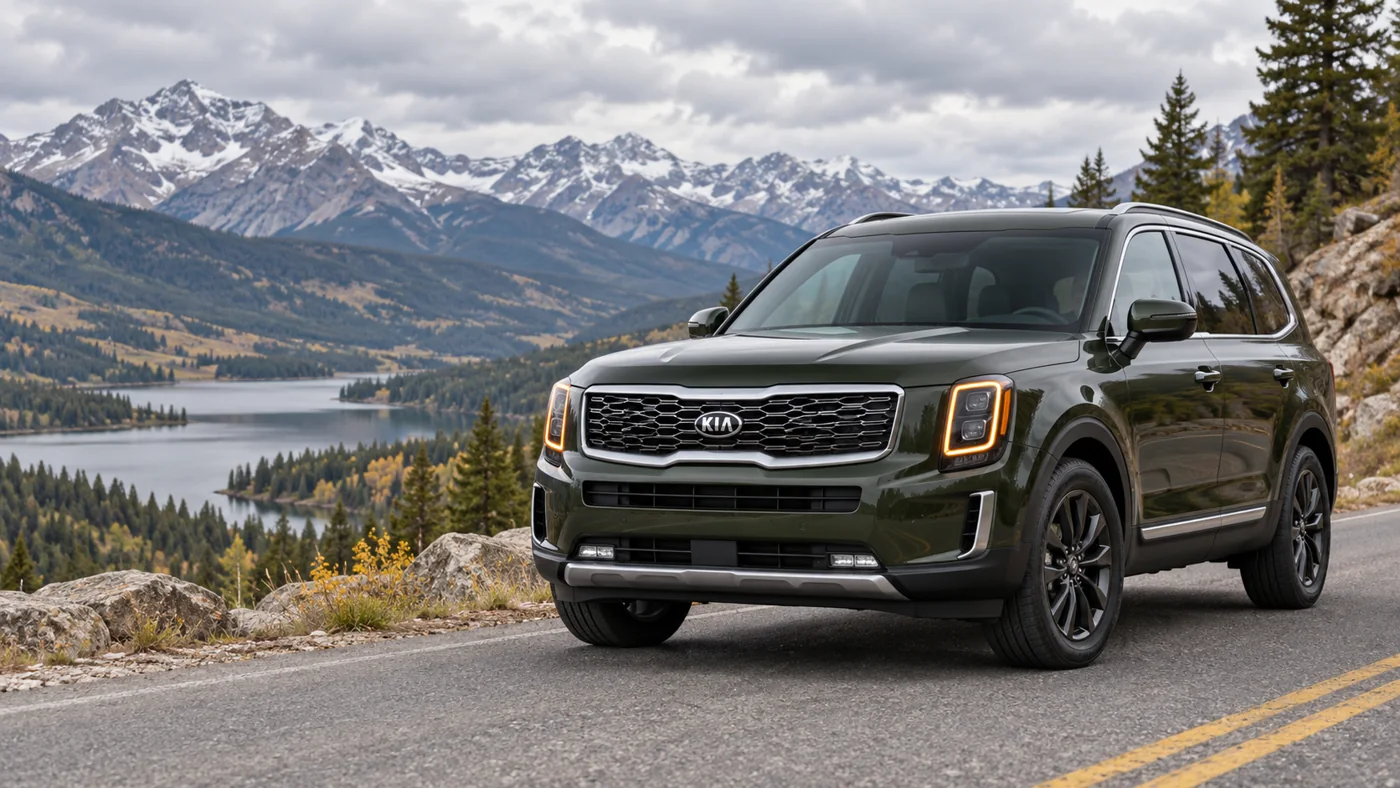
Why Kia created the Telluride
Its basic purpose was straightforward: carry people and their luggage in a vehicle that felt comfortable on an ordinary weekday and convincing on a long journey. A substantial third row, a broad cabin and an upright body made that purpose visible. The rugged styling gave it an identity beyond being simply a larger family car.
The production Telluride was conceived around American buyers, designed in California and assembled in Georgia. At its launch, it was Kia’s largest vehicle, with seating for up to eight. Its name connected that practical family brief with Telluride, Colorado, rather than with a purely technical model designation. [1]
What did the Telluride replace?
Borrego: the earlier large-SUV chapter
The closest historical comparison in Kia’s U.S. range is the Borrego. Introduced for 2009, it offered three rows on a separate frame, with V6 and V8 engine choices. That made it a different engineering proposition from the later Telluride. [2]
The Telluride can be understood as a successor to the Borrego’s role in the range, but it was a new nameplate rather than a second-generation Borrego. That distinction matters: the connection is market position, not a shared sequence of generations.
Sorento: a companion in the range
Telluride did not replace the Sorento. Kia’s own 2023 announcement describes Telluride being assembled alongside Sorento in Georgia. They therefore belonged to the same range, rather than representing an old model and its replacement. [3]
For an owner comparing manuals or parts, the practical conclusion is simple: neither a Borrego document nor a Sorento document becomes applicable just because the vehicles occupy a related place in Kia’s SUV story.
Explore the milestones
Choose an era to read its place in the story. Without JavaScript, every milestone remains visible below.
A concept establishes the idea
Kia unveiled the Telluride concept at the North American International Auto Show on January 11, 2016. Its seven-passenger, three-row layout and upright stance proposed a larger, more premium SUV direction for the brand.
This was a design study, not the first production generation. It established the name and the broad ambition without making every show-car feature a promise for the showroom. [4]
The idea becomes a production SUV
The production Telluride made its Detroit debut on January 14, 2019, as a 2020 model. Its launch specification combined a 291-hp 3.8-litre V6, an eight-speed automatic and available all-wheel drive. A monocoque structure and independent suspension distinguished its construction from the frame-based Borrego. [1]
A more technical, more adventurous expression
The 2023 update introduced revised exterior detailing, a redesigned dashboard and available paired 12.3-inch displays. X-Line and X-Pro broadened the range, with the latter adding equipment aimed at more demanding use.
The key historical point is continuity: the 3.8-litre V6 and eight-speed automatic remained. This was a significant refresh of the first generation, not the arrival of generation two. [3]
The second generation changes the powertrain story
Kia presented the second-generation Telluride at the Los Angeles Auto Show on November 20, 2025. The larger new model introduced turbocharged gasoline power and the nameplate’s first available hybrid. The hybrid was announced with 329 hp and a six-speed automatic. [5]
By March 10, 2026, Kia reported that the 2027 Telluride was on sale and hybrid versions had begun arriving in showrooms. A 2027 model-year badge therefore does not mean the vehicle first appeared during calendar year 2027. [6]

Why the shape matters
The Telluride’s visual appeal rests on a few clear ideas: an upright front, a broad shoulder and a roofline that communicates usable interior space. Those proportions help it read as a substantial SUV without relying entirely on decorative details.
That is also why a facelift can look important without being a new generation. Headlamps, screens and trim treatments change the impression of the vehicle, while its basic architecture can remain familiar. The 2023 update is the clearest example in the Telluride story.
Generations at a glance
This overview follows the U.S. model-year sequence. Filter it to distinguish an early car, the refreshed first generation and the new second generation.
| Period | Place in the history | Powertrain direction | Key distinction |
|---|---|---|---|
| 2020–2022 | First generation, original design | 3.8-litre V6 / eight-speed automatic | The original production Telluride formula |
| 2023–2025 | First generation, refreshed | V6 architecture retained | Revised cabin and styling; X-Line and X-Pro |
| 2027 onward | Second generation | Turbo gasoline / available turbo hybrid | A larger new model and the first Telluride hybrid |
Why is 2026 missing? Kia skipped the 2026 U.S. model year during the changeover. The outgoing vehicle was the 2025 model, and its replacement reached showrooms in 2026 wearing a 2027 model-year designation. [7]
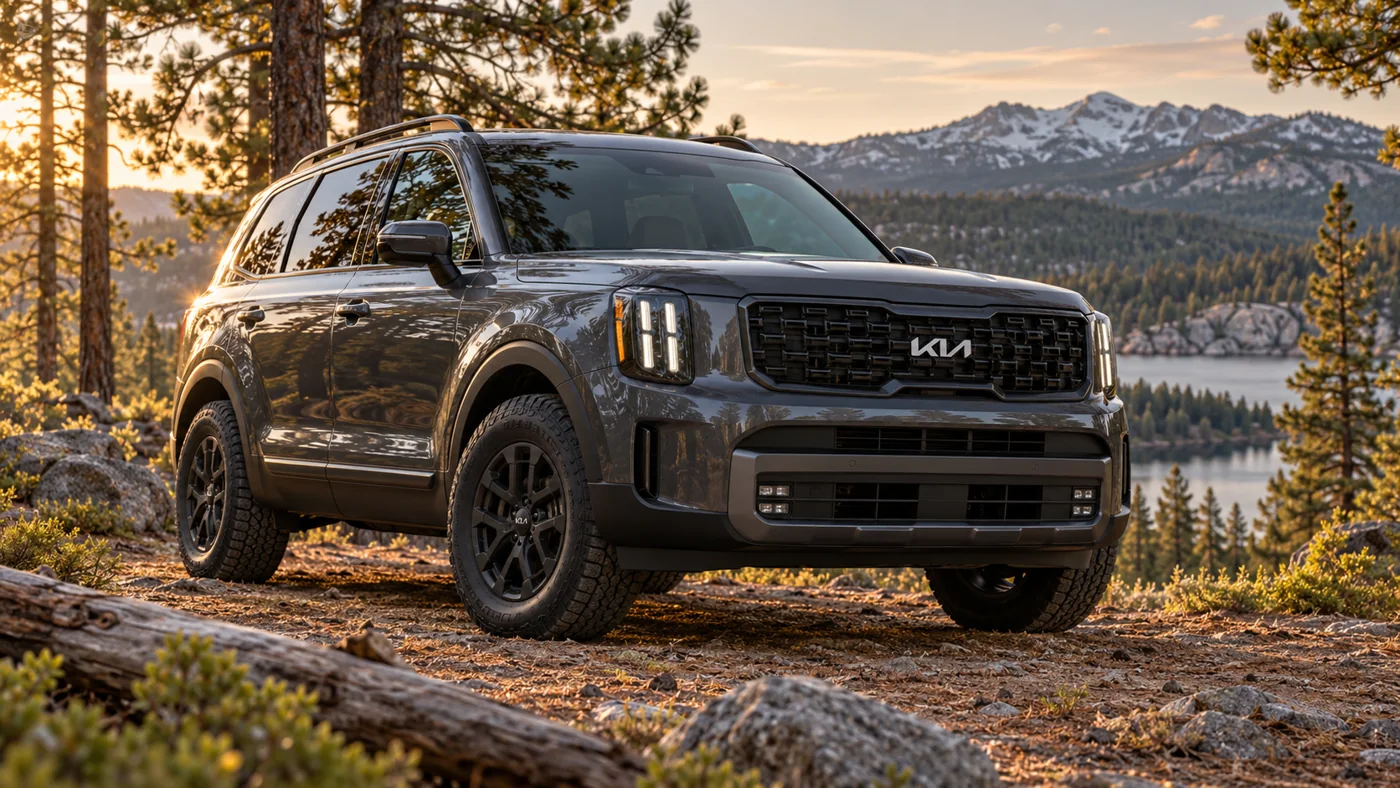
What changed with the second generation?
The change was more than a new front end. Kia increased the wheelbase to 116.9 inches and overall length to 199.2 inches, making more room part of the new model’s brief. Hybrid power also broadened the way buyers could approach a large three-row SUV. [5]
The resulting story is one of expansion rather than abandonment. The cabin still has to work for passengers, the body still has an upright presence, and the model still serves as a flagship three-row SUV. The new powertrains and larger package add another layer to that original purpose.
Common questions about the Telluride story
Is the 2023 Telluride a second-generation model?
No. It is the refreshed first generation. Kia identifies the 2027 model as the second generation. A changed dashboard or headlamp design alone is not a reliable guide to generation.
Was Telluride simply a renamed Borrego?
No. Borrego is useful historical context for Kia’s large-SUV ambitions, but Telluride launched as a new model with different construction. Calling it a successor in market role is more accurate than treating it as a renamed or directly evolved Borrego.
Does the hybrid belong to the original generation?
No. The production Telluride’s first available hybrid arrived with the second-generation 2027 model. Do not use first-generation V6 maintenance information for a hybrid simply because both vehicles share the Telluride name.
Why does this history distinguish model years from calendar years?
A manufacturer can launch a vehicle before the calendar year printed in its model designation. The first production Telluride debuted in 2019 as a 2020 model; the second generation reached U.S. showrooms in 2026 as a 2027 model. Manual selection should follow the vehicle’s documented model year and specification.
Sources and historical references
U.S.-market overview. Dates and model details checked against the following published references.
- Kia: production Telluride debut — January 14, 2019.
- Kia: 2009 Borrego — construction and model background.
- Kia: 2023 Telluride refresh — April 13, 2022.
- Kia: Telluride concept debut — January 11, 2016.
- Kia: second-generation Telluride introduction — November 20, 2025.
- Kia: 2027 Telluride and hybrid market introduction — March 10, 2026.
- Kelley Blue Book: Kia confirms the model-year changeover — October 23, 2025.