
Kia Telluride: Tires and wheels / Tire rotation
To promote uniform tread wear across all four wheels, it is strongly recommended to rotate the tires on your Kia Telluride every 8,000 miles (13,000 km), or even sooner if uneven wear patterns begin to emerge.
During every routine tire rotation service, carefully inspect each wheel assembly for dynamic balance and overall structural integrity.
While performing a rotation, thoroughly examine the tread surface and sidewalls for physical damage or unusual wear. Accelerated or irregular wear typically stems from improper inflation pressure, misaligned suspension geometry, unbalanced wheel assemblies, hard emergency braking, or aggressive cornering maneuvers. Carefully check for internal cord separation, sidewall bulges, or localized tread bumps. Immediately replace any tire displaying these structural defects or any tire where internal reinforcement fabric or steel cords are visible. After completing the rotation sequence, adjust the front and rear cold tire inflation pressures to match exact factory specifications and torque all wheel lug nuts to the specified standard of 11–13 kgf·m (79–94 lb-ft).
Refer to Tires and wheels.
Take advantage of the tire rotation process to perform a thorough visual inspection of the disc brake pads and rotors for remaining thickness and operational wear.
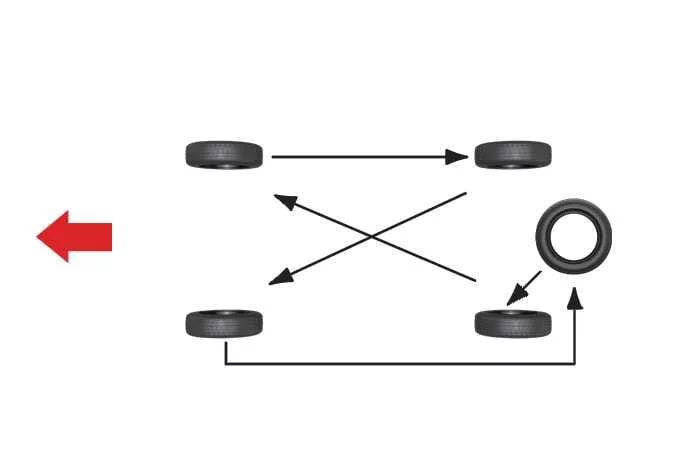
|
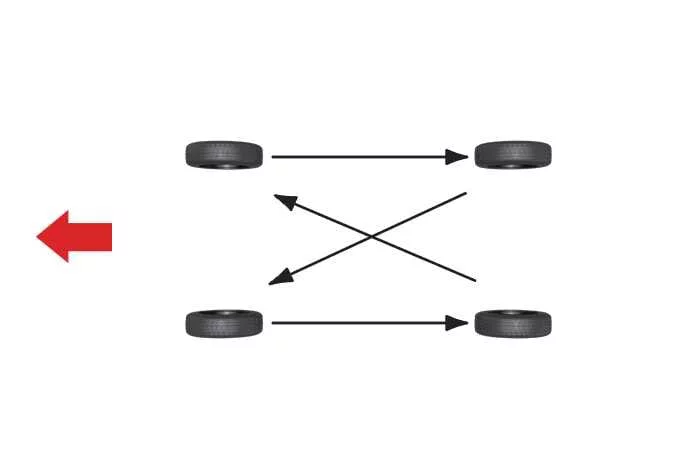
|
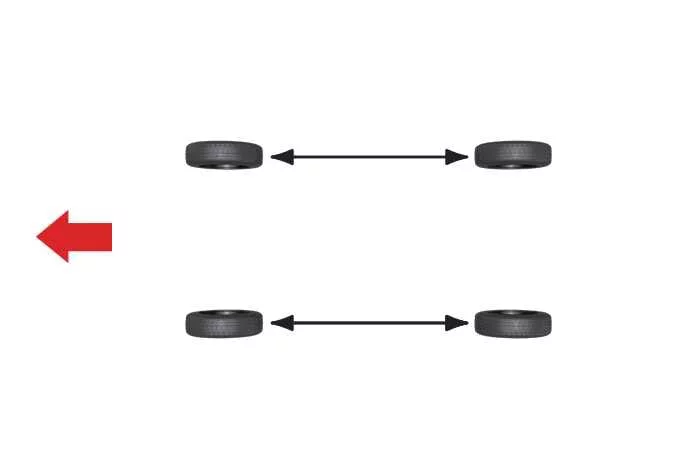
|
Always swap radial tires featuring asymmetric tread patterns directly front-to-rear on the same side of the vehicle, avoiding cross-swapping between the left and right positions.
WARNING
Mixing tires
Never mix bias-ply tires and radial-ply tires on the same vehicle under any circumstances. Combining different tire structural designs severely compromises chassis balance, unpredictable cornering behavior, and potential loss of vehicle control.
 Wheel alignment and tire balance
The steering geometry and wheel assemblies on your Kia Telluride were precisely aligned and dynamic-balanced at the factory to deliver superior driving dynamics, high-speed tracking, and maximum tread longevity...
 Tire traction
Operating your Kia Telluride on worn tread, underinflated or overinflated tires, or hazardous road surfaces like wet asphalt, slush, and black ice significantly diminishes overall tire traction, extending braking distances and compromising vehicle stability...
Other information:
Kia Telluride (LQ2, 2027-2026) Owner's Manual: Ergo-motion seat (Driver's seat): (if equipped)
Setting the Ergo-motion seat The Ergo-motion seat in the Kia Telluride uses adjustable air pockets to provide customized cushioning and support for the driver. By changing the support around the hips, waist, and lumbar area, this feature helps reduce fatigue and improve comfort during long drives, continuous highway travel, or changing driving conditions.
Kia Telluride (LQ2, 2027-2026) Owner's Manual: Reverse guide light: (if equipped)
When the transmission is shifted into R (Reverse), the reverse lamps illuminate automatically, and the reverse guide light projects additional light onto the ground behind the Kia Telluride. This improves rearward visibility while also making nearby pedestrians and drivers more aware that the vehicle is backing up.