
Kia Telluride: All Wheel Drive (AWD): (if equipped) / AWD precautions
Tires
Always give special attention to the tires on your Kia Telluride, especially if it is equipped with an AWD system.
Because the AWD system continuously distributes power to all four wheels, tire condition plays a critical role in maintaining predictable handling, stability, and overall driving performance.
-
Whenever tire replacement is necessary, install four tires that match in size, type, tread pattern, brand, and load rating. Using tires that differ from the original specifications may negatively affect the handling characteristics of your Kia Telluride, increase drivetrain stress, and potentially lead to steering instability or rollover.
-
Rotate the front and rear tires every 8,000 miles (13,000 km) to promote even tread wear and help maintain balanced AWD performance.
-
During colder weather, inspect tire pressure at least once each month and keep every tire inflated to the pressure specified on the Kia tire information label.
-
If tire chains are required, install them on all four wheels of your AWD vehicle whenever applicable, and limit driving distance as much as possible to reduce unnecessary stress on the AWD system. Refer to the Winter driving section for additional guidance.
Towing

|

|
An AWD-equipped Kia Telluride must always be transported using flatbed equipment or a wheel lift together with dollies so that all four wheels remain off the ground. Additional towing procedures are described in the Towing section.
Vehicle inspection
-
When the vehicle is positioned on a service lift, never operate the front wheels separately from the rear wheels. All four wheels should rotate together.
-
Never apply the parking brake while the vehicle is operating on a lift, as doing so may damage AWD drivetrain components.
WARNING
Your Kia Telluride is equipped with tires specifically selected to deliver the intended ride quality, stability, and handling. Never install tires or wheels that differ from the original size, type, tread pattern, brand, or load capacity. Mismatched tires can compromise vehicle control, reduce AWD effectiveness, and increase the risk of steering problems or rollover, which could result in serious injury.
WARNING
Jacked vehicle
Never start the engine or allow the wheels to rotate while an AWD vehicle is supported by a jack. If the rotating tires contact the ground, the vehicle may move unexpectedly, causing it to slip off the jack and creating a serious safety hazard.
TIP
An AWD Kia Telluride should never be towed with sling-type equipment. Always use a wheel lift with dollies or a flatbed tow truck.
Dynamometer testing
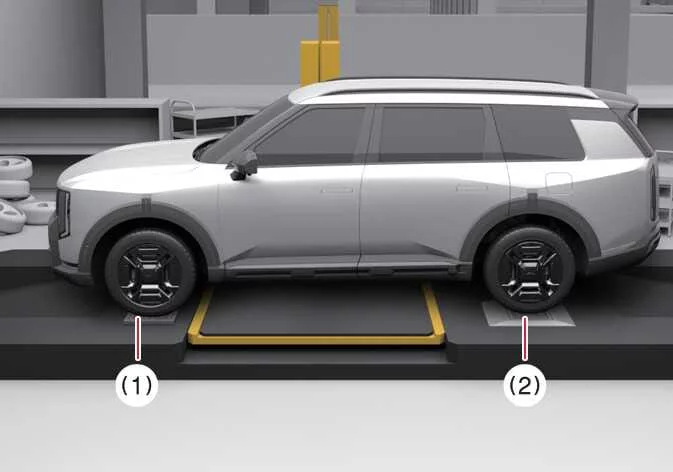
AWD vehicles should ideally be tested using a dedicated four-wheel chassis dynamometer.
If testing must be performed on a two-wheel roll tester, follow the procedure below carefully.
|
|
-
Verify that all tires are inflated to the recommended pressure before beginning the test.
-
Position the driven wheels on the roll tester (1) to perform the speedometer inspection.
-
Release the parking brake completely.
-
Place the non-driven wheels onto the temporary free rollers (2).
WARNING
Dynamometer testing
-
Always use tires and wheels that match the original specifications. Different sizes or types can negatively affect the safety and handling of the Kia Telluride, increasing the possibility of steering failure or rollover.
-
Never start or operate an AWD vehicle while it is supported only by a jack. The vehicle could slip or fall, resulting in severe injury or death.
-
Remain clear of the area directly in front of the vehicle whenever it is running in gear on a dynamometer. Unexpected movement could cause serious injury.
TIP
Do not apply the parking brake while performing dynamometer testing, as this may interfere with the procedure and place unnecessary stress on the AWD system.
 Safe AWD operation
Before driving Mastering the dynamics of an All-Wheel Drive (AWD) vehicle is essential for confident driving. Do not rely exclusively on your habits from conventional Front-Wheel Drive (FWD) vehicles; the Kia Telluride AWD system provides different handling characteristi..
 Ground View Monitor (GVM): (if equipped)
The Ground View Monitor (GVM) gives the driver a detailed view of the area directly beneath and in front of the Kia Telluride, helping identify obstacles that may not be visible from the driver's seat...
Other information:
Kia Telluride (LQ2, 2027-2026) Owner's Manual: Basic function
The basic functions of Forward Collision-Avoidance Assist are designed to warn the driver first and, when needed, provide braking assistance to help reduce the risk or severity of a forward collision. These functions include: Collision Warning Emergency Braking Stopping vehicle and ending brake control Collision Warning Collision Warning Collision Warning can alert the driver through a blinking Forward Safety warning light (), a warning message on the cluster, an audible warning, and steering wheel vibration when the system detects a possible forward collision.
Kia Telluride (LQ2, 2027-2026) Owner's Manual: Securing a child restraint seat with “Tether Anchor” system
Figure 1. 2nd row seat (7 passenger vehicle) Figure 2. 2nd row seat (8 passenger vehicle) Figure 3. 3rd row seat Before attaching the tether strap, first secure the Child Restraint System (CRS) using either the LATCH lower anchors or the vehicle seat belt.