Kia Telluride: All Wheel Drive (AWD): (if equipped) / Safe AWD operation
Before driving
-
Mastering the dynamics of an All-Wheel Drive (AWD) vehicle is essential for confident driving. Do not rely exclusively on your habits from conventional Front-Wheel Drive (FWD) vehicles; the Kia Telluride AWD system provides different handling characteristics, meaning you must drive at more moderate speeds when in AWD mode to maintain full control.
-
Ensure that every passenger is properly secured with a seat belt before the vehicle is in motion.
-
Maintain an upright, alert posture, positioning yourself slightly closer to the steering wheel than you might in a sedan. Adjust your steering wheel to a height and reach that feels comfortable and natural for your driving style.
-
When navigating unpaved, loose, or rugged terrain, maintain a firm, steady grip on the steering wheel to effectively manage feedback from the road surface.
WARNING
AWD
-
Always reduce your speed significantly before entering a turn. Because AWD vehicles, including the Kia Telluride, may have a higher center of gravity compared to standard FWD passenger cars, they are more susceptible to rollover if you attempt to corner at excessive speeds.
-
Avoid abrupt or erratic steering inputs, such as sudden lane changes or aggressive, sharp turns, which can destabilize the vehicle.
-
The risk of a rollover incident escalates dramatically if you lose control of your vehicle while traveling at highway speeds.
-
In the event of a collision, the safety benefits of seat belts are life-saving; unbelted occupants are at a significantly higher risk of fatal injury than those who are properly restrained.
-
Loss of control often stems from two or more wheels leaving the pavement, followed by a driver’s instinct to overcorrect. If your Kia Telluride leaves the road, resist the urge to steer sharply; instead, ease off the accelerator, maintain a steady wheel, and reduce your speed gradually before attempting to reenter the road safely.
WARNING
Steering wheel
|
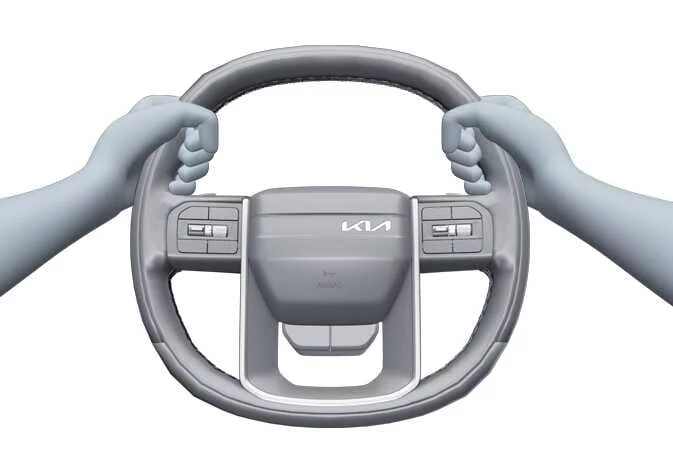
When navigating unpaved or uneven roads, never grip the inside of the steering wheel rim. If an impact with a hidden object on the ground causes a sudden, violent rebound of the steering wheel, your arm could be injured, or you might involuntarily lose control of the steering entirely.
NOTE
AWD
-
Never attempt to drive through standing water that is deeper than the undercarriage or the bottom edge of your vehicle.
-
Always verify the effectiveness of your brakes immediately after traversing mud or deep water. To do this, press the brake pedal lightly and repeatedly while moving at a slow pace until you feel the normal, firm braking response return.
-
If your Kia Telluride is frequently used in demanding off-road conditions like sand, thick mud, or water, you should adhere to a shortened scheduled maintenance interval. Additionally, perform a thorough wash of the exterior and, crucially, the entire underbody after any off-road excursion.
-
Tire condition is critical for AWD performance because driving torque is distributed across all four wheels. Always equip your vehicle with four matching tires of the same size, brand, and tread type to ensure uniform handling.
-
The sophisticated drivetrain of an AWD vehicle requires special care during recovery; it cannot be towed by a standard tow truck. If towing is necessary, a flatbed tow truck must be used to prevent mechanical damage.
-
Driving in environments that require AWD pushes your vehicle to higher stress levels than standard road driving. Maintain lower speeds and remain vigilant for changes in surface composition or traction. If you are uncertain about the safety of the terrain, stop and evaluate the best way to proceed.
Driving on snow-covered or icy roads
-
Start your movement gradually by applying the accelerator pedal with light, measured pressure to prevent wheel spin.
-
For enhanced traction on frozen surfaces, utilize high-quality snow tires or approved tire chains.
-
Increase your following distance significantly to allow ample room to stop, as stopping distances on ice and snow are much longer.
-
Leverage the engine's braking force to assist with speed control when descending hills. Coasting in neutral makes it harder to adjust your trajectory, so aim to minimize the use of the foot brake on slippery inclines.
-
Prevent skidding by avoiding aggressive maneuvers, such as high-speed travel, rapid acceleration, sudden or heavy braking, and sharp steering inputs.
-
If your vehicle loses momentum while climbing a hill, it can be very difficult to regain traction. Maintain a generous distance from other drivers and proceed at a slow, constant pace.
NOTE
Mud or snow
If a wheel begins to slip in mud or snow, you may regain momentum by carefully and steadily increasing pressure on the accelerator pedal. However, avoid revving the engine at high RPMs for an extended duration, as this can overheat or damage your Kia Telluride's AWD system components.
Driving in sand or mud
-
Maintain a slow, steady momentum and apply the accelerator pedal gently to prevent the tires from digging in and slipping.
-
Keep a safe distance from any vehicle ahead to avoid having to stop unexpectedly in soft terrain.
-
Constantly monitor your speed and remain aware of changing road conditions ahead.
-
Avoid common mistakes like speeding, rapid acceleration, sudden braking, or sharp turns, all of which significantly increase the likelihood of getting stuck.
-
If your wheels stop rotating while stuck in sand, snow, or mud, it is likely that the system has entered a protective mode to prevent transmission damage; this is a safety feature, not a mechanical failure.
NOTE
Forcibly moving your vehicle to get it out of mud or sand can cause:
-
Physical damage to your Kia Telluride body panels or components
-
Severe wear or damage to your tires
-
Engine overheating due to prolonged high-load, low-speed operation
-
Damage to or total breakdown of your transmission, differential, or AWD systems
If excessive wheel slip occurs in sand or mud, you may sink deeper. If this happens, try placing a sturdy stone, wooden plank, or tree branch under the affected tires to create traction, then attempt to extract the vehicle by gently rocking it back and forth.
Driving up or down hills
-
Always approach hill climbs or descents at the straightest angle possible. When traversing steep inclines, be hyper-aware of the risk of rollover, which can be triggered by the steepness of the grade, unstable terrain, or the presence of mud and water.
WARNING
Hills
Navigating steep hills in your Kia Telluride can be extremely hazardous, as even a minor shift in wheel angle can destabilize the vehicle. The vehicle may become unstable if it loses forward momentum, even if you are applying power. A rollover can happen with little warning, leaving insufficient time to correct the situation, which may result in serious injury or death.
Driving through water
-
Avoid driving through deep or moving standing water whenever possible.
-
If driving through shallow water is unavoidable, come to a complete stop, set your vehicle to TERRAIN MODE, and maintain a slow, constant speed below 5 mph (8 km/h).
-
Do not attempt to shift gears while moving through water.
WARNING
Driving through water
Speed is critical when driving through water. If you enter water too quickly, it can splash into the engine compartment, dampen the ignition or electrical systems, and cause your Kia Telluride to stall suddenly. If the engine dies while the vehicle is in a tilted position, it could cause the vehicle to lose balance and potentially roll over.
Additional driving conditions
-
Research and become familiar with the specifics of the off-road conditions you plan to encounter before setting out.
-
Maintain complete focus while off-road and actively avoid areas that appear excessively dangerous or impassable.
-
Drive at a reduced speed when navigating areas with heavy crosswinds.
-
Always slow down before turning. AWD and 4WD vehicles like the Kia Telluride have a higher center of gravity than conventional 2WD passenger vehicles, which increases the susceptibility to rolling over during rapid cornering.
-
Maintain a firm, controlled hold on the steering wheel at all times during off-road driving.
WARNING
Wind danger
Driving in high-wind conditions is challenging because the vehicle’s higher center of gravity can reduce steering precision and stability; always reduce your speed in these conditions to maintain control of the Kia Telluride.
Transmission overheated

|
|
|
|
-
The transmission can reach elevated temperatures if you operate the vehicle under heavy load on extremely muddy or sandy surfaces for extended periods.
-
When the transmission reaches a critical temperature, a protective safety mode is activated; the message "Transmission Hot! Park with engine on" will appear in the instrument cluster, accompanied by an audible alert.
-
Immediately pull over to a safe area, stop the Kia Telluride, leave the engine running, apply the brakes, shift into P (Park), and allow the system to cool down.
-
Ignoring this warning will likely degrade driving conditions, potentially resulting in jerky shifts or inconsistent gear changes. To restore normal performance, it is vital that you remain parked with the engine idling for several minutes until the temperature drops.
-
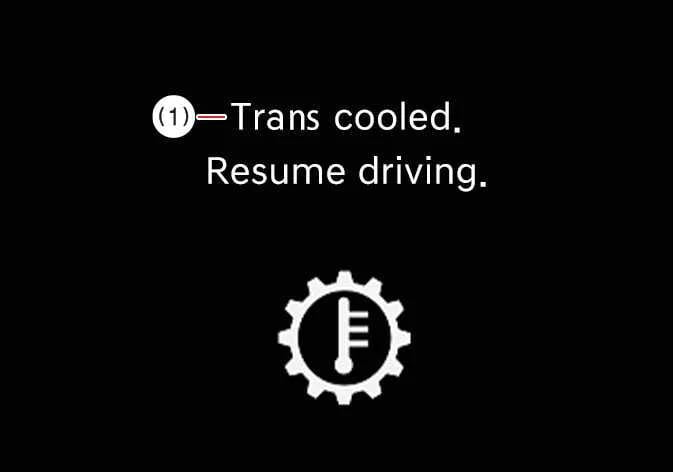
You may safely resume driving once the "Trans cooled. Resume driving" message is displayed on your instrument panel.
If a warning message on the instrument cluster fails to clear or continues to blink, have your Kia Telluride inspected promptly by an authorized Kia dealer.
 TERRAIN MODE. TERRAIN MODE selection
TERRAIN MODE enhances the Kia Telluride's driving capability by coordinating the AWD system, engine, transmission, and braking performance according to the current road surface, including snow, mud, sand, and other low-traction conditions...
 AWD precautions
Tires Always give special attention to the tires on your Kia Telluride, especially if it is equipped with an AWD system. Because the AWD system continuously distributes power to all four wheels, tire condition plays a critical role in maintaining predictable handling, stability, and overall dr..
Other information:
Kia Telluride (LQ2, 2027-2026) Owner's Manual: Smart Cruise Control display and control
You can effortlessly monitor the operational status of the Smart Cruise Control (SCC) system by accessing the "Driving Assist" view located within your Kia Telluride instrument cluster. For a comprehensive overview of how to customize these views, please refer to the detailed LCD display mode settings in your owner’s manual.
Kia Telluride (LQ2, 2027-2026) Owner's Manual: Good driving practices
Never shift from P (Park) or N (Neutral) into another gear while pressing the accelerator pedal. Never move the transmission into P (Park) while the Kia Telluride is still in motion. Always bring the vehicle to a complete stop before selecting R (Reverse) or D (Drive).