
Kia Telluride: Child Restraint System (CRS) / Selecting a child restraint system (CRS)
When choosing a Child Restraint System (CRS) for your child, always consider the following recommendations to ensure the highest level of protection while traveling in your Kia Telluride.
-
Verify that the CRS carries a certification label indicating compliance with the applicable Federal Motor Vehicle Safety Standards (FMVSS 213).
-
Select a child restraint that matches your child's height, weight, and age. This information is typically listed on the CRS label or in the manufacturer's instructions.
-
Choose a CRS that is compatible with the seating position where it will be installed in your Kia Telluride.
-
Carefully read and follow every warning, installation procedure, and usage instruction supplied by the CRS manufacturer.
-
The American Academy of Pediatrics offers additional child passenger safety guidance and child restraint recommendations at https://www.healthychildren.org.
WARNING
Holding children
Never carry a child in your arms or on your lap while riding in a moving vehicle. During a collision, even at relatively low speeds, the forces generated can pull the child from your grasp and cause severe or fatal injuries. Always secure your child in a properly installed Child Restraint System that is appropriate for their size.
WARNING
Unattended children
Never leave children unattended inside a vehicle. Interior temperatures can rise rapidly, even on mild days, creating a serious risk of heat-related injury or death.
WARNING
Seat belt use
Never allow two occupants to share a single seat belt. Each seating position is designed for one properly restrained occupant only. Sharing a seat belt significantly reduces its protective capability during a crash.
CRS types
There are three primary categories of Child Restraint Systems: rear-facing child seats, forward-facing child restraints, and booster seats. The appropriate choice depends on the child's age, height, weight, and developmental stage.
Rear-facing child seats
|
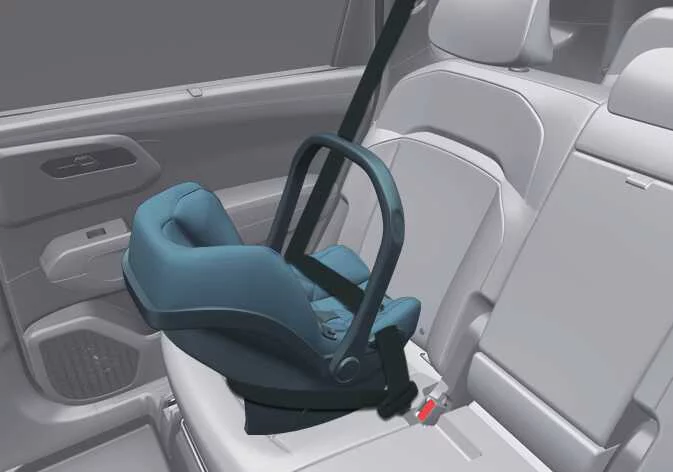
A rear-facing child seat supports the child's head, neck, and spine by distributing crash forces across the back of the restraint. The integrated harness helps keep the child securely positioned during sudden stops or collisions while minimizing stress on the neck and spinal column.
Rear-facing child restraints should always be installed in one of the rear seating positions.
All children under one year of age should always ride in a rear-facing Child Restraint System.
Many convertible and 3-in-1 child seats provide higher rear-facing height and weight limits, allowing children to remain in the safer rear-facing position for a longer period.
Continue using a rear-facing CRS until your child reaches the maximum height or weight specified by the child restraint manufacturer. Once those limits are exceeded, transition to a forward-facing child restraint equipped with an internal harness.
Forward-facing child restraints
|
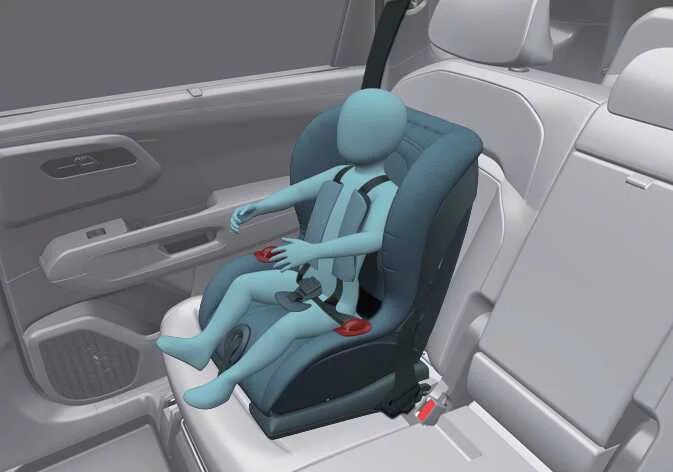
A forward-facing child restraint secures the child using an integrated harness designed to distribute crash forces across the strongest parts of the body. Keep your child in this type of restraint until the maximum height or weight limit established by the CRS manufacturer has been reached.
After your child outgrows the forward-facing child restraint with a harness, the next appropriate step is transitioning to a booster seat.
Booster seats
A booster seat is designed to improve the fit of the vehicle's seat belt by raising the child into the proper seating position. This allows both the lap belt and shoulder belt to rest correctly across the body.
Continue using a booster seat until your child is large enough for the vehicle's seat belt to fit properly without additional support. A correctly fitted lap belt should lie low and snug across the upper thighs rather than the abdomen, while the shoulder belt should cross the center of the chest and shoulder without touching the neck or face. For maximum safety, children under 13 years of age should always ride properly restrained in the rear seats of the Kia Telluride.
 Children always in the rear
Children younger than 13 years of age should always ride in the rear seats and be properly restrained. Keeping children in the rear seating area significantly reduces the risk of injury during a collision, emergency braking, or sudden evasive maneuver...
 Installing a child restraint system (CRS)
After selecting the appropriate Child Restraint System (CRS) for your child, verify that it fits correctly in your Kia Telluride before installation. A properly fitted and securely installed child seat is essential for providing the highest level of protection during everyday driving and in the even..
Other information:
Kia Telluride (LQ2, 2027-2026) Owner's Manual: Blind-Spot Collision-Avoidance Assist malfunction
Check Driver Assistance system. If Blind-Spot Collision-Avoidance Assist is not operating correctly, the Master Warning light () illuminates on the instrument cluster together with a warning message that remains visible for several seconds.
Kia Telluride (LQ2, 2027-2026) Owner's Manual: Abbreviation
This reference index provides a comprehensive guide to the essential technical acronyms and system abbreviations utilized throughout the official owner documentation for your Kia Telluride, ensuring clear understanding of its advanced features and engineering specifications.