
Kia Telluride: If you have a flat tire (with spare tire) / Removing and storing the spare tire
The compact spare tire is mounted externally under the rear chassis of your Kia Telluride, directly beneath the cargo floor structure.
Removing the spare tire
To lower and release the spare tire assembly from its underbody carrier, follow these steps:
-
Open the rear liftgate to access the trunk area.
-
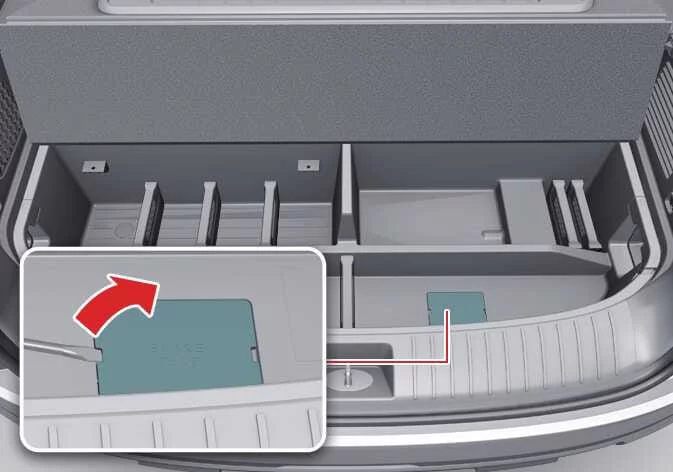
Locate the protective rubber access cover over the spare tire winch bolt and remove it.
If your model features an upper tool storage tray, unlatch the retaining clamp and set the tray aside to expose the drive bolt.
-
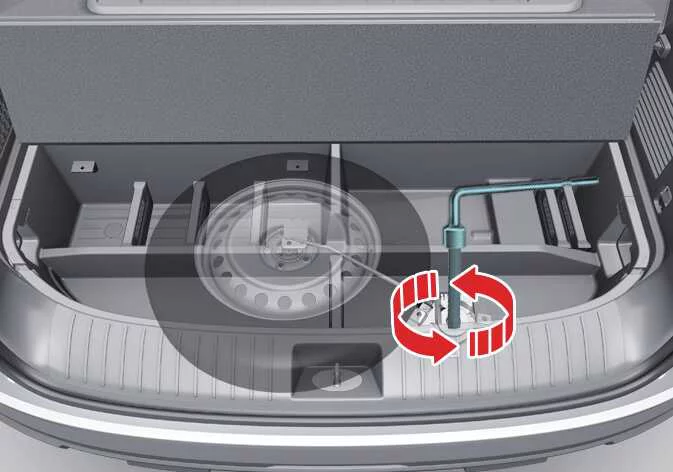
Assemble the hoist drive socket together with the lug nut wrench to create a winch crank handle.
-
Fit the socket wrench assembly securely onto the exposed hoist hex bolt.
-
Rotate the wrench handle counterclockwise to unwind the winch cable, gradually lowering the spare tire down to the pavement.
-
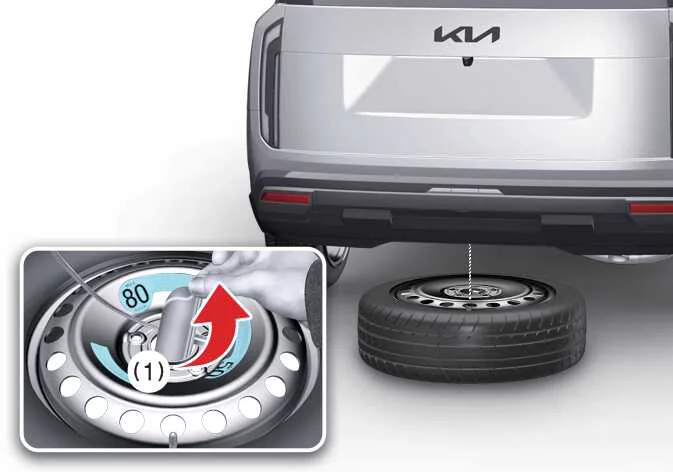
Once the spare tire rests completely flat on the ground, continue unwinding the cable slightly so you can slide the tire out from under the bumper. Do not over-wind or force the cable assembly beyond its slack limit, as excessive torque can kink or snap the internal carrier mechanism.
-
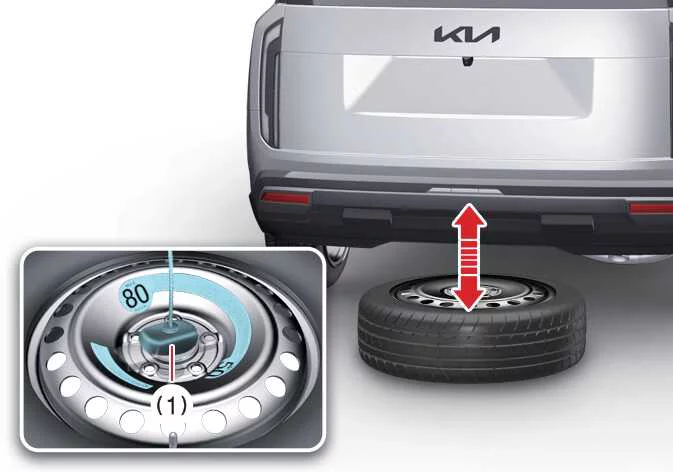
Tilt and pass the central holding plate retainer (1) vertically through the center hub opening of the spare wheel. When extracting or re-attaching the wheel, maintain light tension on the steel cable to prevent binding, overlapping, or backlashing inside the hoist drum.
Storing the spare tire
To securely winch the flat road wheel or spare tire back into the underbody carrier, follow these steps:
-
Position the wheel flat on the ground behind the rear bumper with the outer valve stem side facing upward.
-
Slide the wheel under the chassis center and feed the hoist cable holding retainer plate (1) vertically through the wheel center hub hole until it lays flat against the wheel center bore.
-
Fit the socket wrench onto the winch bolt and turn clockwise until the carrier mechanism clicks distinctly, indicating the wheel is fully raised and torqued flush against the underbody frame support.
WARNING
Touching surface of the cargo area
Do not touch the metal floor panel surfaces of the cargo compartment while the engine is running or immediately after driving, as exhaust heat conduction can cause severe thermal skin burns.
Shut off the engine and allow the underbody exhaust system to cool completely, or wear thick protective work gloves before reaching into the luggage floor to access or store the spare tire components.
 Jack and tools
Lift the floor board panel inside the rear luggage compartment to access the dedicated emergency tool storage tray containing the following service items: ..
 Changing tires
Safely park your Kia Telluride on a flat, solid surface away from moving traffic, engage the electronic parking brake firmly, and turn off the engine completely...
Other information:
Kia Telluride (LQ2, 2027-2026) Owner's Manual: Limitations of the system
Digital Key 2 may not operate correctly under any of the following conditions: The smartphone battery or the Kia Telluride vehicle battery is discharged. NFC or Bluetooth has been turned off in the smartphone settings.
Kia Telluride (LQ2, 2027-2026) Owner's Manual: Paddle shifter
The paddle shifter function allows you to manually select gears while the Kia Telluride remains in D (Drive), providing greater control during acceleration, overtaking, or when driving on winding roads and steep grades. With the gear in D (Drive) The paddle shifter system becomes available when the vehicle speed exceeds 6 mph (10 km/h).