
Kia Telluride: Forward Collision-avoidance Assist malfunction and limitations / Limitations of Forward Collision-Avoidance Assist
While the advanced safety suite in your Kia Telluride is engineered to provide an extra layer of protection on the road, it is important to acknowledge that the Forward Collision-Avoidance Assist (FCA) system has functional limitations. For detailed information regarding the specific constraints of the interior camera system, please consult the section dedicated to the Forward Attention Warning (FAW).
The operational efficiency of the system can fluctuate based on dynamic variables, including the behavior of traffic ahead and your current driving environment. During nighttime driving, the system’s ability to reliably identify vehicles, motorcyclists, pedestrians, and cyclists is naturally reduced compared to daylight conditions, which may lead to temporary system limitations or a total loss of functionality.
Performance may also be impacted by vehicle alignment. If your Kia Telluride or an oncoming vehicle is not traveling in a straight line, the Front Oncoming function may experience a delay in issuing warnings or initiating necessary control measures. Similarly, if a crossing vehicle approaches at an angle outside of the sensor's calibrated detection range, the Junction Crossing warning and control systems may be delayed or fail to activate entirely.
Please note that the Emergency Steering function will automatically conclude as soon as the identified risk factors have dissipated. Furthermore, this steering assistance may deactivate if the driver is holding the steering wheel with excessive force or provides input in the opposite direction of the steering assist. If a potential collision is detected with an additional vehicle, motorcyclist, pedestrian, or cyclist, the Evasive Steering Assist will disengage to prioritize safe maneuvering. Additionally, if the system determines there is physically insufficient space to safely bypass an obstacle, Evasive Steering Assist may not engage.
Drivers should be aware that the Forward Collision-Avoidance Assist in the Kia Telluride is not designed to activate for non-motorized objects such as carts, bicycles, or other items being pushed or pulled by individuals. Furthermore, the system may struggle to operate normally if exposed to significant electromagnetic interference or within the first 15 seconds following vehicle ignition or the initialization of the front-view camera.
The system may operate unpredictably or exhibit abnormal behavior under various conditions, including but not limited to:
-
Sensor obstruction or physical damage.
-
Extreme temperature fluctuations affecting the front-view camera hardware.
-
Obstructions on the windshield directly in front of the camera, such as non-factory tints, films, coatings, cracks, stickers, or insect residue.
-
Accumulation of frost, ice, or moisture on the windshield glass.
-
Visibility compromised by heavy downpours, thick snow, or dense fog.
-
Camera glare caused by direct, intense sunlight.
-
Light reflections bouncing off wet surfaces, such as deep puddles.
-
Foreign objects placed on the instrument panel that may interfere with sensor visibility.
-
Environments that are excessively bright or poorly lit.
-
Rapid light transitions, such as entering or exiting a tunnel.
-
Nighttime driving where headlights are either disabled or obscured.
-
Situations where a pedestrian, cyclist, or vehicle is only partially visible to the sensors.
-
Objects that are buses, heavy-duty trucks, or vehicles carrying oversized, bulky cargo that hangs off the rear.
-
Vehicles or cyclists lacking functional tail lights or utilizing non-standard, unusual lighting configurations.
-
Vehicles with exceptionally high or low ground clearance.
-
Pedestrians, motorcyclists, or vehicles that dart unexpectedly into the path of your Kia Telluride.
-
Front radar sensor damage or misalignment.
-
Extreme temperatures near the front radar unit.
-
Driving through sparse, featureless landscapes like deserts or open meadows where the system lacks reference points.
-
Areas with high concentrations of metallic structures, including construction zones, railroad tracks, or roads with embedded metal plates.
-
Shadows cast across lane markings by guardrails, noise barriers, trees, or medians.
-
Sudden obscuring of your view of the lead vehicle or motorcyclist.
-
The lead vehicle executing sudden lane changes or abrupt braking.
-
The vehicle ahead being heavily covered in snow or mud.
-
Your vehicle undergoing a lane departure or return maneuver.
-
Unstable or erratic driving patterns.
-
Driving within a traffic circle where road curvature obstructs the detection of vehicles ahead.
-
Navigating steep hills where the lead vehicle falls outside the vertical detection range of the camera or radar.
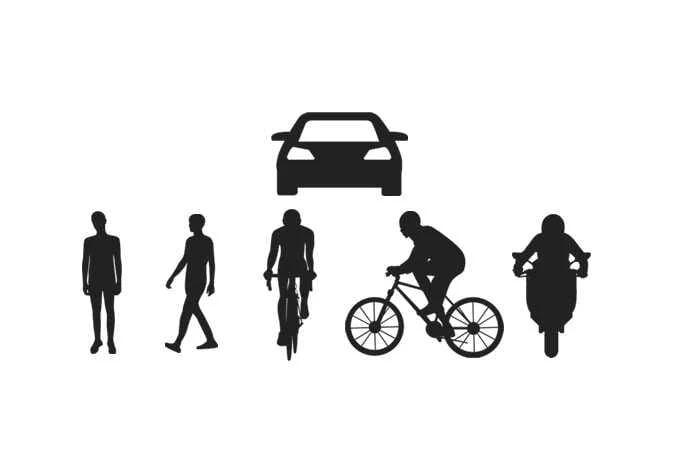
The following illustration provides examples of the types of vehicles, motorcyclists, pedestrians, or cyclists that the front-view camera and front radar sensors of the Kia Telluride are designed to detect:
|
The system may experience challenges in detecting a pedestrian or cyclist ahead if they are:
-
Leaning forward, bending over, or otherwise not standing in a full, upright posture.
-
Clad in clothing or carrying equipment that reduces their visibility to sensors.
-
Moving at high speeds relative to the vehicle.
-
Very short in stature or crouching close to the ground.
-
Traveling against the flow of traffic or displaying signs of impaired mobility.
-
Part of a large, dense crowd.
-
Blending visually into their immediate background environment.
Detection of pedestrians, motorcyclists, or cyclists may also be hindered when your Kia Telluride is traveling:
-
Through visual impairments like steam, smoke, or deep shadows.
-
Inside a tunnel or while crossing a steel bridge.
-
In wide-open areas with minimal infrastructure, such as fields, meadows, or rural settings.
-
Within a parking lot environment.
-
Through toll gates, active construction zones, or on surfaces that are excessively rough or bumpy.
-
Near locations with significant metallic structures, such as railroads or industrial construction sites.
-
Along roads featuring steep inclines or sharp, non-linear curves.
-
Through areas lined with dense trees or frequent street lighting.
-
Along narrow passages characterized by overgrown vegetation or dense trees.
-
In environments exposed to strong electromagnetic waves, radio noise, or electrical interference.
-
With non-standard equipment, such as snow chains, a spare tire, or wheels that differ in size from the factory specifications.
Limitations of Basic function, Junction Turning function, and Direct Oncoming function
The Forward Collision-Avoidance Assist may operate irregularly if targets, including vehicles, cyclists, or pedestrians, are positioned outside the optimized operating range.
The Junction Turning function may encounter limitations in the following situations:
-
When oncoming motorcycles, bicyclists, or vehicles are outside the operating range or are only captured as partial detections.
The Direct Oncoming function may encounter limitations in the following situations:
-
When oncoming motorcycles or vehicles are outside the operational detection distance.
-
When the target vehicle is moving in the same direction as your Kia Telluride rather than toward you.
Junction Crossing, Lane-Change Oncoming, Lane-Change Side, Evasive Steering Assist function: (if equipped)
The Junction Crossing, Lane-Change Oncoming, Lane-Change Side, and Evasive Steering Assist functions may behave unexpectedly under the following circumstances:
-
Ambient temperatures around the front or rear side radars are extremely high or low.
-
Installation of a trailer or cargo carrier near the rear corner radar sensors.
-
Radar sensors obstructed by accumulated snow, heavy rain, mud, or road dirt.
-
Bumper areas surrounding the radar sensors covered by aftermarket additions like bumper guards, stickers, or bike racks.
-
Structural damage to the bumper or misalignment of the radar sensors.
-
Detection paths for the radar sensors blocked by solid walls, pillars, or other large vehicles.
-
Driving on highway entrance or exit ramps.
-
Driving adjacent to high guardrails or tall retaining walls.
-
Another vehicle or motorcyclist tailgating closely or performing a very close pass.
-
Another vehicle or motorcyclist overtaking your Kia Telluride at excessive speeds.
-
Your vehicle performing an overtaking maneuver on another vehicle or motorcyclist.
-
Accelerating at the same speed as a vehicle in the parallel lane, making differentiation difficult for the system.
-
Vehicles moving into or out of the adjacent lane, or when you are merging into a lane occupied by another vehicle.
-
The function detects a bicycle or motorcycle rather than a standard passenger vehicle.
-
The presence of flatbed or low-profile trailers.
-
Detection of large commercial vehicles, such as semi-trucks or full-size buses.
-
The function identifies small mobile obstacles, including strollers, shopping carts, animals, or pedestrians.
-
Detection of low-profile vehicles, such as sports cars.
-
Road visibility is impaired by environmental debris like rain, snow, sand, dust, or oily puddles.
-
Lane markings are faded, worn, or indistinguishable from the road surface.
-
Adjacent lanes terminating or merging, creating complex lane layouts.
-
Roads featuring more than two distinct lane markings.
-
Markings that are complex or compromised by active roadwork.
-
Presence of non-standard road markings like crosswalks, zigzag lines, or road signs that confuse sensor interpretation.
-
Lane boundaries vanishing abruptly, such as at complex intersections.
-
Lanes that are either unusually narrow or excessively wide.
-
Lane markings being obscured by a vehicle traveling directly ahead.
-
Driving in close proximity to the vehicle immediately ahead.
Limitations of Junction Crossing function
The Junction Crossing function may not perform as expected when:
-
Oncoming motorcycles or vehicles are positioned outside the designated operating range.
-
The target vehicle is traveling at a higher speed than your Kia Telluride.
Limitations of Lane-Change Oncoming function, Lane-Change Side function
The Lane-Change Oncoming and Lane-Change Side functions may experience reduced effectiveness in the following scenario:
-
When the activation of these functions might inadvertently introduce a risk of a secondary collision.
Limitations of Evasive Steering Assist function
The Evasive Steering Assist function may not operate normally when:
-
Bicyclists or pedestrians are detected outside the effective operating range.
-
Bicyclists or pedestrians are traversing the path laterally.
-
Targets are within the operating range, but the available roadway space is insufficient to perform a safe evasive steering maneuver.
-
The engagement of Evasive Steering Assist could potentially create a risk of a secondary collision.
TIP
For more comprehensive information regarding the limitations of detecting vehicles in the rear corners and additional safety cautions regarding the rear corner sensor, please refer to the Blind-spot Collision-avoidance Assist (BCA) section of your owner’s manual.
WARNING
-
Driving on a curved road
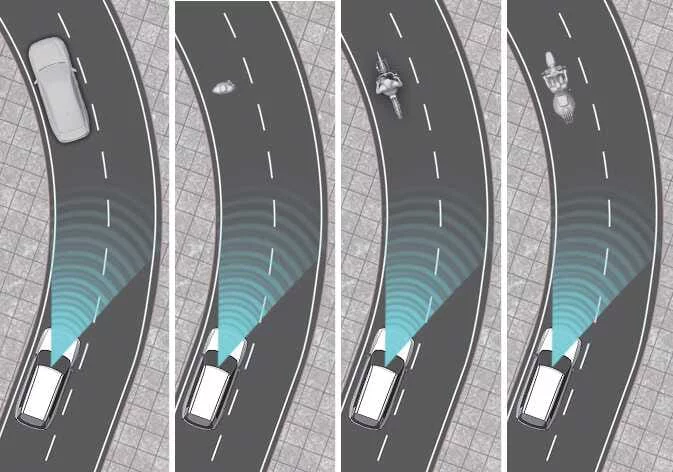
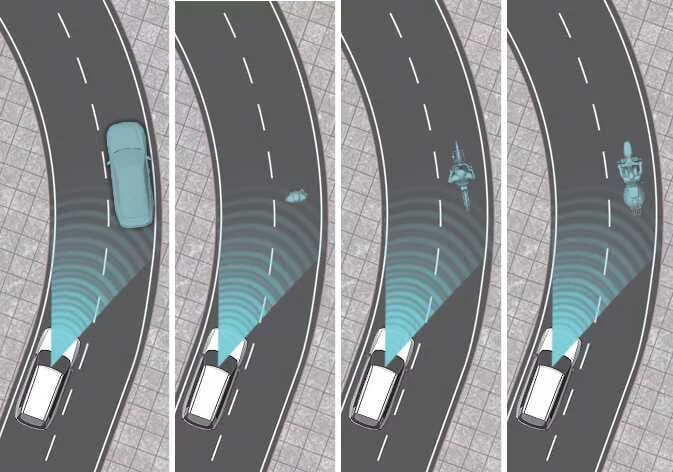
The Forward Collision-Avoidance Assist system in your Kia Telluride may struggle to detect motorcyclists, pedestrians, cyclists, or other vehicles ahead when navigating curved road segments. This can lead to a failure in issuing warnings or applying necessary braking/steering assistance.
When driving through curves, you must always maintain a safe braking distance, actively monitor the road, and be prepared to steer the vehicle and engage the brake pedal manually to adjust speed as needed.
Conversely, on curves, the system might misidentify a vehicle in an adjacent lane or outside your path as an immediate threat. If this occurs, the Forward Collision-Avoidance Assist may trigger unnecessary warnings or apply unintended braking or steering. Always remain vigilant and monitor traffic conditions actively.
-
Driving on an incline
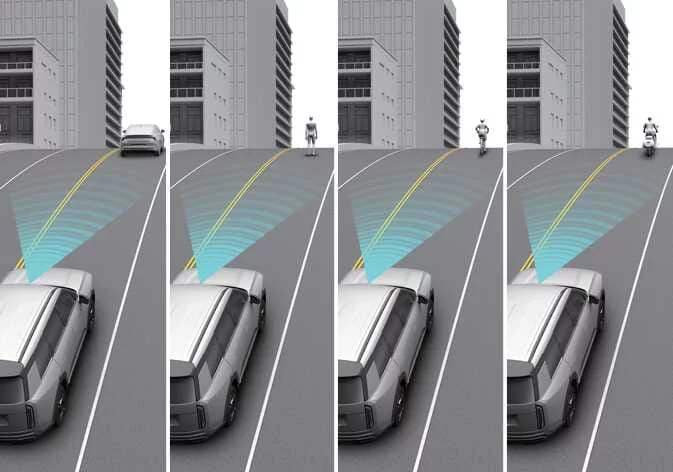
The Forward Collision-Avoidance Assist may fail to detect vehicles, motorcyclists, or pedestrians when your Kia Telluride is traversing uphill or downhill, as the change in vehicle pitch can adversely impact sensor performance.
In such scenarios, the system might not provide the expected warnings, braking, or steering assistance. Additionally, Emergency Braking might trigger prematurely if the system suddenly detects an obstacle ahead during an incline.
Always keep your eyes on the road, manually control your speed, and ensure you maintain a safe following distance regardless of system status.
-
Changing lanes
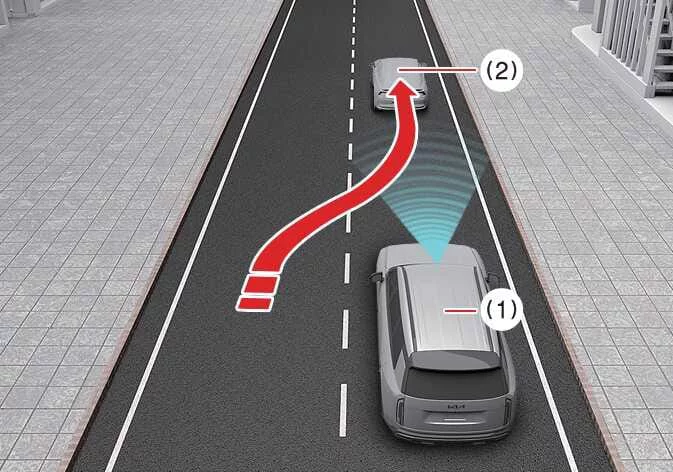
-
Your Kia Telluride
-
Vehicle or motorcyclist changing lanes
When a motorcyclist or vehicle merges into your lane from an adjacent one, detection is only possible once the target is within the sensor’s calibrated range. The Forward Collision-Avoidance Assist may not immediately recognize a vehicle that executes an abrupt lane change.
Always maintain a safe braking distance, and be prepared to manually steer and brake your Kia Telluride if necessary.
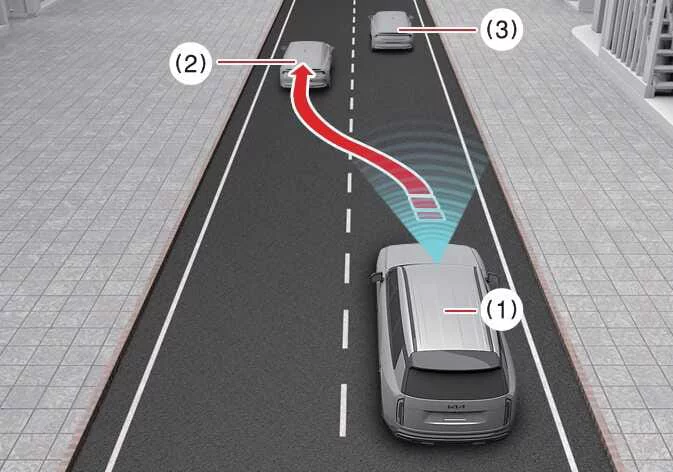
-
Your Kia Telluride
-
Vehicle or motorcyclist changing lanes
-
Same lane vehicle
When a vehicle ahead of you merges into another lane, the Forward Collision-Avoidance Assist may not instantly detect a new vehicle or motorcyclist that has appeared ahead of you. In such events, you are responsible for maintaining a safe braking distance and engaging the brake pedal if speed reduction is required.
-
-
Detecting a vehicle
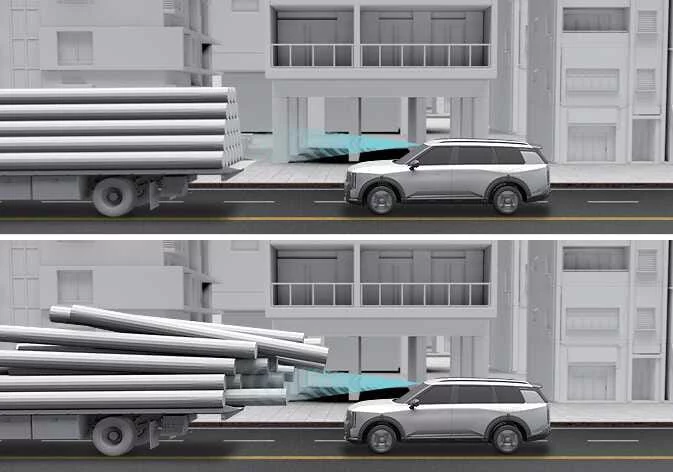
Exercise extreme caution when following a vehicle that has cargo extending significantly from the cab or one that features high ground clearance. The Forward Collision-Avoidance Assist of your Kia Telluride may be unable to detect cargo projecting from the rear of the lead vehicle. Always maintain a safe braking distance from the rearmost object and be prepared to intervene manually by steering and braking.
WARNING
-
When towing a trailer or another vehicle, you should turn OFF the Forward Collision-Avoidance Assist system to ensure safe operation and prevent false activations.
-
The Forward Collision-Avoidance Assist may occasionally activate if it incorrectly identifies objects that share similarities with vehicles, pedestrians, cyclists, or motorcyclists.
-
The Forward Collision-Avoidance Assist does not provide activation for bicycles, carts, or other objects that are actively pushed or pulled by cyclists or pedestrians.
-
The system's performance may be compromised if exposed to strong sources of electromagnetic interference.
-
The Forward Collision-Avoidance Assist will generally remain inactive for approximately 15 seconds immediately following vehicle startup or the initialization sequence of the front-view camera.
TIP
For more comprehensive information regarding the limitations of detecting vehicles in the rear corners and additional safety cautions regarding the rear corner sensor, please refer to the Blind-spot Collision-avoidance Assist (BCA) section of your owner’s manual.
This device complies with Part 15 of the FCC rules.
Operation is subject to the following two conditions:
-
This device may not cause harmful interference, and
-
this device must accept any interference received, including interference that may cause undesired operation.
TIP
Changes or modifications to this system not expressly approved by the party responsible for compliance could void your authority to operate the equipment.
 Forward Collision-Avoidance Assist malfunction
Check Driver Assistance system When Forward Collision-Avoidance Assist is not operating correctly, the Master warning light (), the Forward Safety warning light (), and the Emergency Steering w..
 Lane Keeping Assist (LKA)
When driving above the required operating speed, Lane Keeping Assist (LKA) monitors lane markings or the edge of the roadway using the front camera. If the Kia Telluride begins to drift out of its lane without the turn signal being activated, the system can provide steering assistance to help guide ..
Other information:
Kia Telluride (LQ2, 2027-2026) Owner's Manual: Smart Cruise Control settings
Smart Cruise Control While the vehicle is ON, tap Setup > Vehicle > Driver Assistance > Driving Convenience > Smart Cruise Control on the infotainment system screen to set the preferred distance, acceleration, and reaction speed settings.
Kia Telluride (LQ2, 2027-2026) Owner's Manual: Driving with a trailer
Towing a trailer with your Kia Telluride requires practice and careful preparation. Before beginning a long trip, spend time becoming familiar with how the vehicle responds with the additional weight of the trailer. Acceleration, braking, cornering, and overall handling will feel different than when driving without a trailer, and your combined vehicle length will require extra attention in all driving situations.